
Manufacturing Material Requirements Planning System Architecture
A complete 2009 system design for material requirements planning in manufacturing plants, covering operational workflows, MRP calculation logic, data structures, user interactions, controls, and reporting. The verified outcome is the design artifact itself; later implementation and commercial results remain unconfirmed.
- Logic, data, UI, reports
- Design scope
- UML, DFDs + logical data model
- Methods
- 57-page report + UML/logic/UI diagrams
- Design artifact
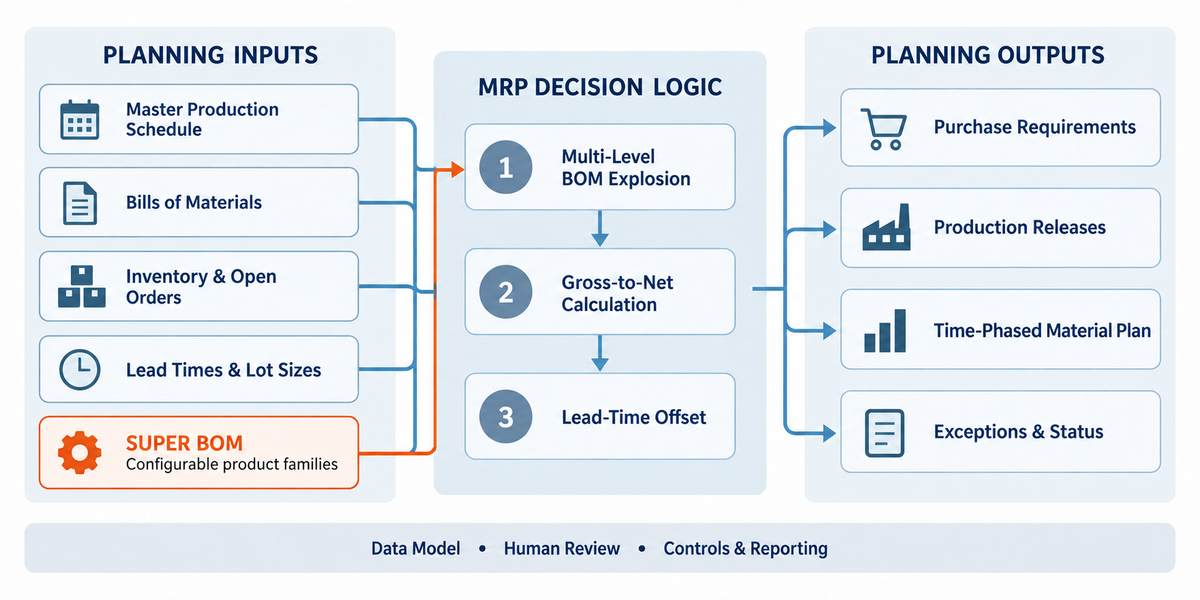
From manufacturing requirements to a system specification
In 2009, my employer asked me to define the architecture for a material requirements planning system intended for manufacturing organizations. I completed the system analysis and design and handed over a detailed specification connecting production plans, product structures, inventory information, and purchasing activity to time-phased material decisions.
Context and challenge
Material requirements planning depends on more than the underlying calculations. It requires consistent definitions of materials and products, multi-level bills of materials, inventory availability, scheduled receipts, planning horizons, lot sizes, lead times, and safety parameters. It must also coordinate information across production planning, engineering, warehouses, purchasing, and related operational functions.
The challenge was to turn these interacting requirements into a coherent system that could determine what materials were needed, in what quantities, and when purchasing or production activity should begin.
My role and contribution
I authored the system-analysis and design package and served as the system architect and analyst. I:
- decomposed the system into hierarchical processes and information flows;
- specified gross-to-net material-requirements calculations and lead-time offset logic;
- designed the logical data model and relationships among materials, bills of materials, warehouses, inventory, planning horizons, production schedules, suppliers, and purchase orders;
- defined user workflows for material records, multi-level BOMs, configurable product structures, master production schedules, processing, review, and control;
- designed interface screens, validation behavior, access controls, planning outputs, and management reports.
The design allowed users to run planning calculations step by step—with opportunities for review and adjustment—or automatically across an entire production schedule.
I introduced a Super BOM approach for configurable and variable-demand products. The design consolidated equivalent product and subassembly structures into a weighted planning representation, allowing material requirements to be forecast before the precise final product configuration was known.
What was created
The resulting 57-page Farsi specification combined process diagrams, entity and relationship models, calculation rules, worked MRP records, screen designs, error conditions, and reporting requirements.
Its planned outputs included time-phased production and purchasing requirements, material-usage reports, production and purchase instructions, order-status tracking, comparisons between forecasts and actual deliveries, delay analysis, and graphical schedule views.
The report also defined the system boundary. Capacity planning, demand management, production control, and certain inventory and commercial functions were identified as possible future extensions or dependencies on other enterprise systems rather than presented as completed capabilities.
For Make-to-Order and Engineering-to-Order settings, I designed a Super BOM mechanism that identified structurally equivalent products, validated their corresponding components, and calculated a composite planning structure using expected product-mix percentages. This allowed common material requirements to be planned while preserving the eventual product-specific BOMs.
Evidence and current status
The completed and handed-over design report is the verified outcome of the engagement. It demonstrates the depth and breadth of the architecture, but it does not establish that software was subsequently completed, deployed in a plant, sold commercially, or evaluated through operational performance measures.
I left the company after the handoff and do not currently have reliable evidence about later development or commercialization. Those possible outcomes are therefore excluded from this account.
Why it matters
This work demonstrates an early ability to translate manufacturing operations into a structured decision system—connecting domain concepts, planning algorithms, enterprise data, human review, and implementation requirements within one architecture.
Related work
Discuss an Industry or Research Problem
I collaborate with asset-intensive organizations, research teams, and technical founders on problems involving maintenance, fleets, reliability, asset lifecycle, operational modeling, and system architecture.
If your organization has data, analytical models, or technical capability but still lacks a usable decision system, I would be interested in understanding the problem. Schedule a 20-minute introductory conversation to discuss the problem, its current constraints, and whether there is a useful basis for collaboration.