
Large-Scale Flight and Maintenance Optimization
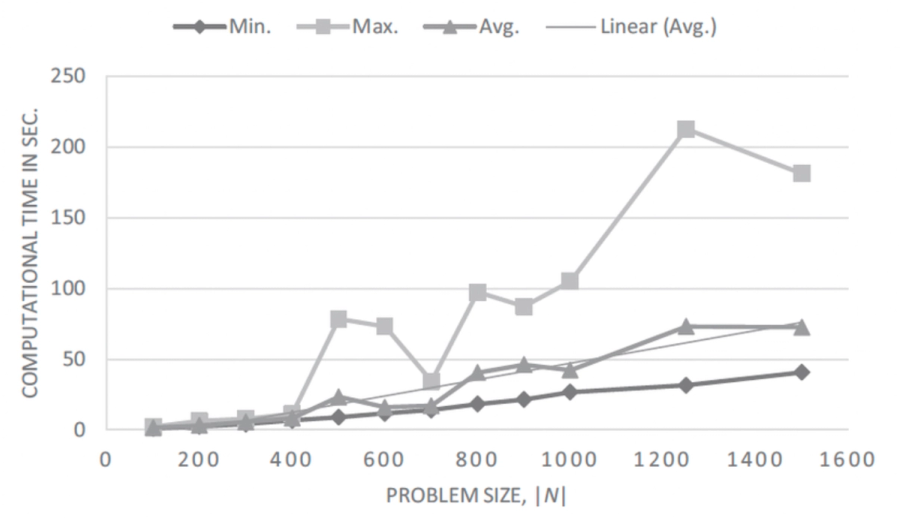
I developed and computationally validated a mixed-integer method that plans aircraft utilization and preventive maintenance together for instances representing about 1,500 assets. Tested cases reached verified optimal solutions in under seven minutes; the work remains a research implementation, not an operational deployment.
- ≈1,500 assets
- scale in the computational test instances
- <7 minutes
- runtime for optimal solutions
- Peer-reviewed
- generalized formulation and solution method are published
One planning problem, not two
Aircraft operations and preventive maintenance compete for the same finite fleet. When they are planned separately, an operational schedule may appear feasible until maintenance intervals, station capacity, or required demand are considered.
This work treats those decisions as one optimization problem. The objective is to preserve fleet availability while determining how assets should be used and when they should enter preventive maintenance.
My contribution
In research published with Andrew J. Yu, I developed a generalized mixed-integer formulation that extended an existing Flight and Maintenance Planning framework into a broader Operations and Maintenance Planning problem. I worked on the mathematical formulation, the adapted solution methodology, the upper-bound procedure, and the computational experiments used to evaluate its performance.
The work builds on the earlier exact FMP algorithm developed by Andreas Gavranis and George Kozanidis. My contribution was to extend the planning structure and solution approach to accommodate a wider operational setting, including multiple operation types, preventive-maintenance requirements, and maintenance-station constraints.
What was created
The resulting research implementation coordinates operational assignment and preventive-maintenance timing over a finite planning horizon. It represents operational demand, usage-based maintenance intervals, maintenance duration, and station capacity within a single constrained model.
The solution method uses problem structure, decomposition, and upper-bound logic to narrow the search for feasible schedules. Unlike a heuristic result with an unknown optimality gap, the reported large-scale test cases produced solutions whose optimality was verified.
Computational validation
For tested instances representing approximately 1,500 assets, the method reached verified optimal solutions in under seven minutes. These experiments establish that the tested formulation and algorithm were computationally tractable at that scale.
The result is computational rather than operational. The method has not been reported as deployed in an airline or fleet operations center, and the research does not establish measured reductions in downtime or observed improvements in live-fleet availability. The runtime also should not be interpreted as evidence of a production-ready real-time system.
Current status
The core generalized formulation and solution method were published in 2018. The broader Flight and Maintenance Planning research program remains active through related work on mission scheduling, reliability, and the possible incorporation of prognostic health information.
Those later directions are related research extensions, not deployed capabilities of the original implementation.
Why it matters
The work demonstrates that operations and maintenance decisions can be evaluated together at a scale relevant to large asset fleets. It also provides a traceable way to determine whether a schedule satisfies operational demand, maintenance timing, and capacity constraints simultaneously.
Its practical value remains to be established through an operational pilot using live planning data and workflow requirements.
Figures
Related work
Discuss an Industry or Research Problem
I collaborate with asset-intensive organizations, research teams, and technical founders on problems involving maintenance, fleets, reliability, asset lifecycle, operational modeling, and system architecture.
If your organization has data, analytical models, or technical capability but still lacks a usable decision system, I would be interested in understanding the problem. Schedule a 20-minute introductory conversation to discuss the problem, its current constraints, and whether there is a useful basis for collaboration.