
RecomAid: A Governed Platform for Academic Recommendation Workflows
Recommendation letters often start from memory and a blank page. RecomAid is a governed platform that connects academic evidence to faculty-authored letters and gives admissions reviewers a cited evidence layer. It is in partnership and adoption development, not a claim of widespread institutional deployment.
- 60
- Active Users
- Live at recomaid.com
- Product availability
- ≈3 months
- UML design period

From a writing task to an operational workflow
Academic recommendations are often assembled from scattered records, email exchanges, and a professor’s memory. RecomAid treats the process as a governed workflow: students organize relevant academic experiences, professors review the evidence and add their own assessments, and AI assists with drafting while the professor retains control of the final letter.
The live platform supports structured experience records, guided recommendation requests, professor feedback, request tracking, letter generation, editing, and version management. Its public workflow is described on the RecomAid platform and features page.
My role and contribution
I conceived, designed, developed, and deployed RecomAid end to end. I spent approximately three months modeling the system and its user interactions in UML before implementing the production platform.
My work included the workflow and system architecture, React frontend, Python/FastAPI backend, PostgreSQL data model, Git-based development process, database migrations, deployment on Render, role-aware interfaces, administrative functions, and ongoing production maintenance. I used Cursor and other AI coding assistance during implementation, while personally directing and reviewing the architecture, database structure, migrations, application behavior, and deployment.
As a professor, I have also been the platform’s primary professor-role user. That direct operational use has informed successive revisions to the request, feedback, drafting, and approval workflows.
Governed AI and prompt engineering
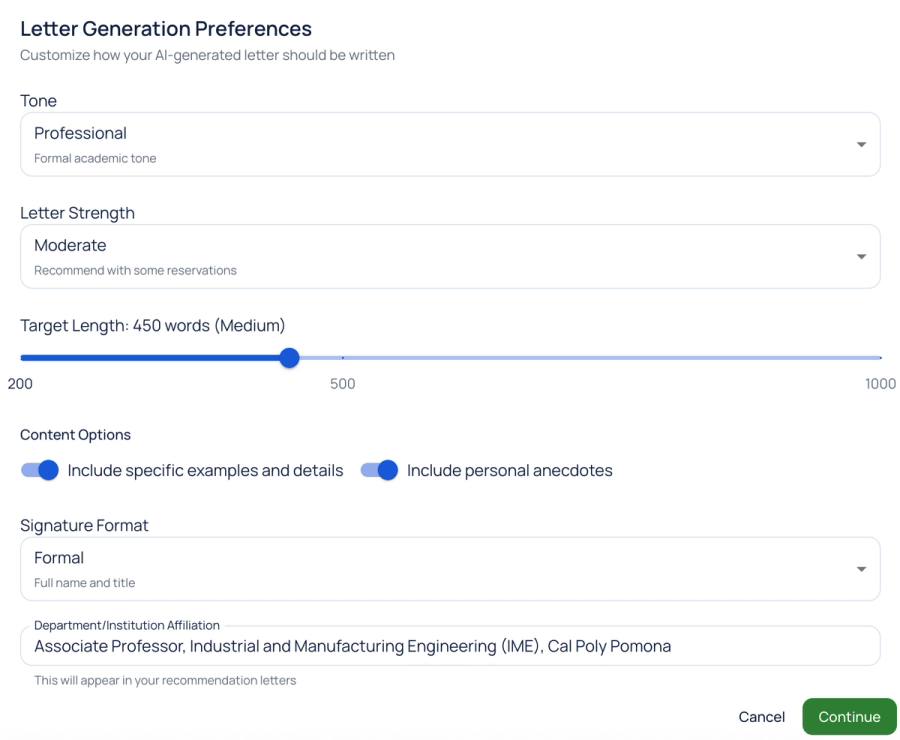
The AI layer is integrated into the workflow rather than presented as a general-purpose writing box. Letter generation combines structured student experiences, professor feedback, per-letter instructions, individual writing preferences, and system-wide rules.
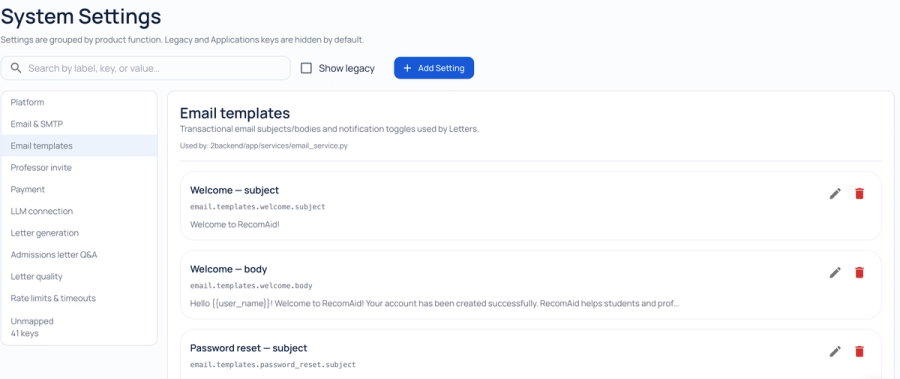
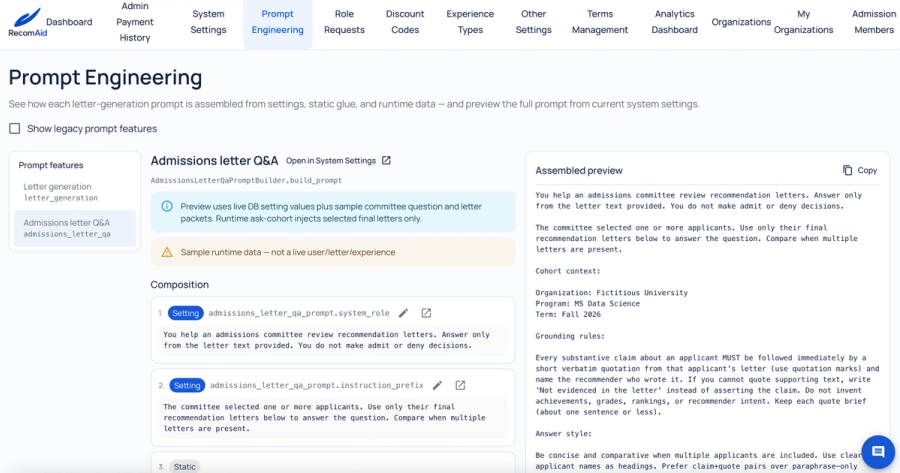
I designed an extensive system-owner environment for managing model configuration, prompt components, generation policies, quality settings, limits, and related operational controls. The prompt architecture composes global instructions, professor-specific preferences, and request-specific evidence into a controlled meta-prompt. A dedicated prompt-engineering interface exposes the composition and can preview the resolved prompt without initiating a model call.
Professors remain responsible for reviewing, editing, approving, and finalizing the resulting letter. Administrative and system-owner responsibilities are separated so that routine user and organization management does not automatically grant control over prompts, platform configuration, or financial settings.
Platform architecture
The platform uses shared authentication, persistent structured data, multi-role accounts, and role-aware application views for students, professors, administrators, and the system owner. Both interface behavior and backend operations reflect these role boundaries.
The resulting system is more than an AI drafting feature: it coordinates evidence collection, review, communication, authorship, versioning, and finalization across multiple participants. The supporting architecture and current technical scope are documented in the internal platform summary.
Validation and current status
RecomAid currently has 60 active users and has gone through multiple rounds of user validation and iterative improvement. These results establish that it is a functioning production platform rather than a conceptual prototype.
The evidence does not yet establish broad faculty adoption, institutional deployment, or quantified improvements in letter quality or preparation time. Because I have been the principal professor-role user, broader validation with independent faculty members remains particularly important.
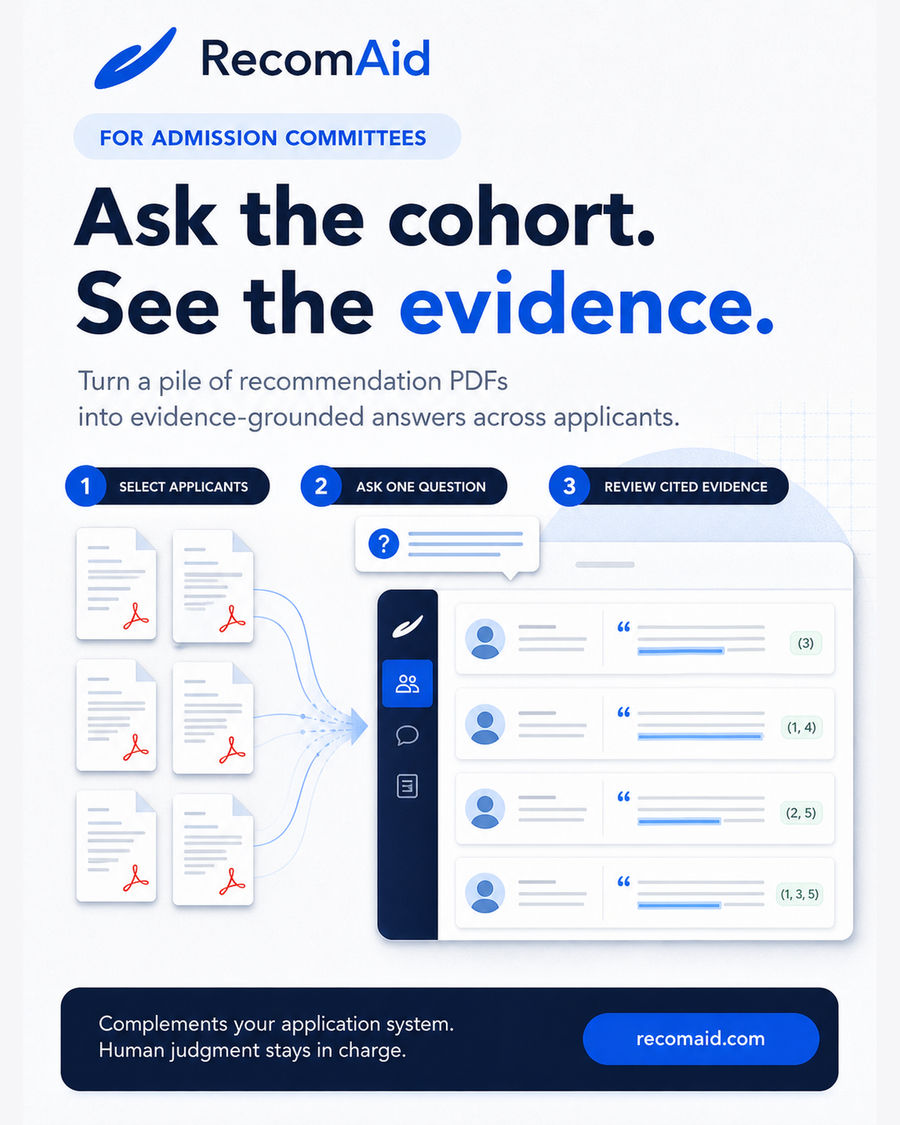
RecomAid is now being developed toward university pilot partnerships. Its admissions proposition describes cohort-level, evidence-grounded review of recommendation letters, but the supporting technical material identifies the institutional foundation and letter-intelligence functions as in progress. They should therefore be presented as active development rather than a deployed institutional result.
Why it matters
RecomAid demonstrates my ability to translate a domain problem I know firsthand into a working, governed product: modeling the workflow, defining system boundaries, engineering the data and AI layers, operating the production environment, and improving the system through use.
The longer-term objective is to make RecomAid a trusted standard for recommendation-letter workflows. That is the product direction—not yet a claim of market leadership or institutional standardization.
Figures

Links
Discuss an Industry or Research Problem
I collaborate with asset-intensive organizations, research teams, and technical founders on problems involving maintenance, fleets, reliability, asset lifecycle, operational modeling, and system architecture.
If your organization has data, analytical models, or technical capability but still lacks a usable decision system, I would be interested in understanding the problem. Schedule a 20-minute introductory conversation to discuss the problem, its current constraints, and whether there is a useful basis for collaboration.